
This week on Embracing Intensity, I’m thrilled to finally sit down with the powerful and passionate Inger Shaye Colzie, a therapist and coach working at the intersection of ADHD, identity, and cultural experience. Inger shares her journey of being diagnosed with ADHD later in life, after decades of navigating systems and expectations that didn’t see her neurodivergence—or the unique challenges that come with being a Black woman with ADHD.
Together, we dive into her experiences growing up gifted but overlooked, her path to founding the ADHD Black Professionals Alliance, and how she helps others own their fire and intensity without apology. Inger’s insight, humor, and realness make this an episode you won’t want to miss.
P.S. We’re planning to bring Inger back for a guest call in the Embracing Intensity Community during the 2026 speaker season—I’d love your feedback on upcoming topics and guests!
About Inger Shaye Colzie
Inger is a therapist, ADHD coach, and the founder of the ADHD Black Professionals Alliance. Diagnosed later in life, she now uses her lived experience, clinical knowledge, and coaching tools to support other Black women navigating life, work, and relationships with ADHD. Through her practice and community, she creates spaces for healing, advocacy, and unapologetic self-discovery.
 Spotify
 Apple Podcasts
 iHeartRadio
 Amazon Music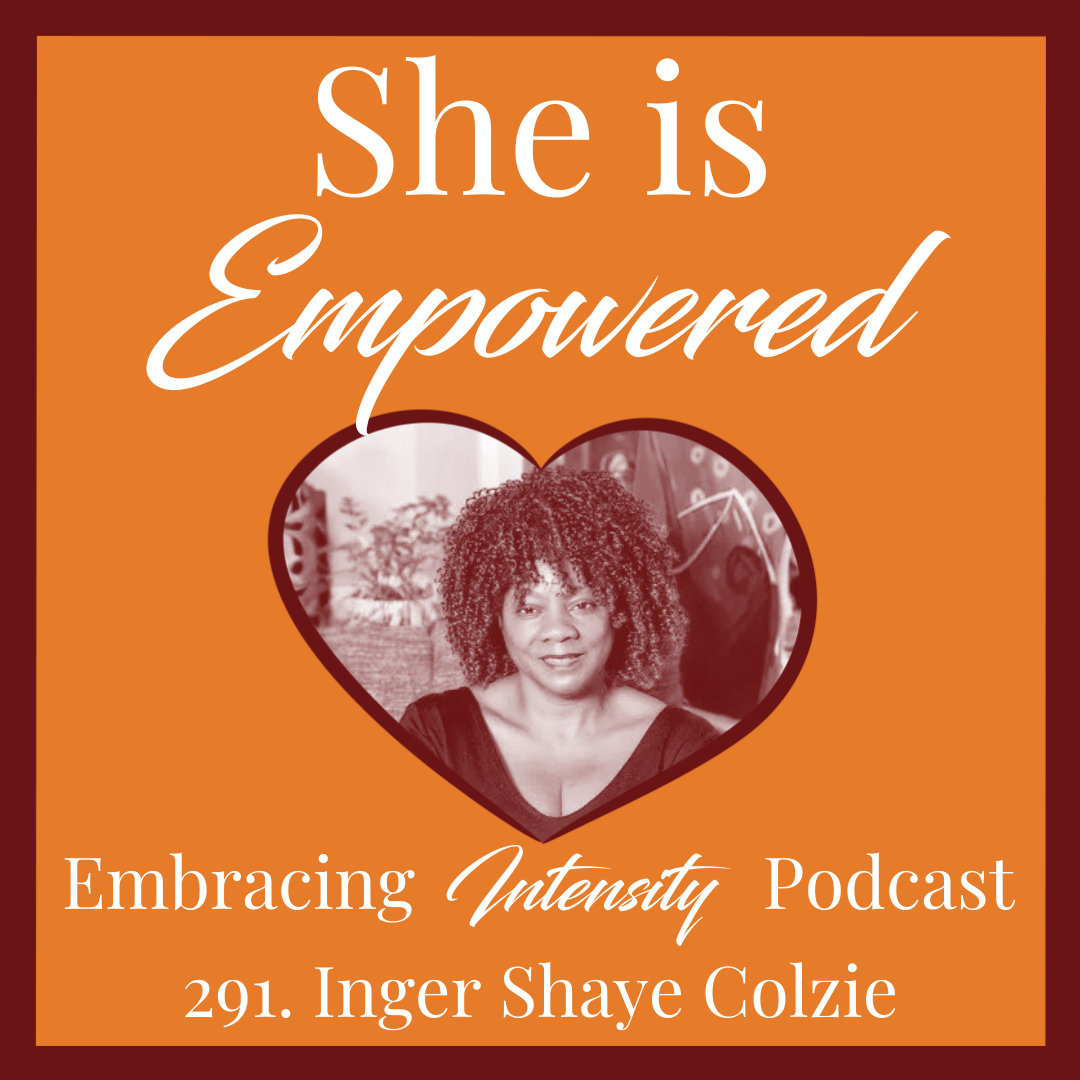
Explore More!
Giftedness * Identity * Intensity * Neurodivergence * Positive Disintegration * Relationships * Self Care * Self Regulation * Twice Exceptionality
In This Episode:
-
The experience of being undiagnosed with ADHD well into adulthood—and what finally led her to seek answers
-
Growing up as an intense, passionate child whose energy was often misunderstood
-
Why culturally relevant care is essential for Black women with ADHD
-
The emotional impact of living with ADHD in a world not built for neurodivergent minds
-
How diagnosis and coaching helped her reframe her identity and harness her gifts
-
Creating the ADHD Black Professionals Alliance as a safe and empowering space
-
Turning down the dial—or turning it up with intention
-
The importance of coaching, community, and embracing your whole self
Whether you’re navigating ADHD yourself or supporting others who are, this episode offers compassion, clarity, and community. Inger’s story is a reminder that it’s never too late to rewrite the narrative—and that when we embrace our fire, we light the way for others.
🎧 Listen now and share with someone who needs to hear they are not broken—just unseen.
Transcript
* Rough Transcript *
Introduction and Affirmation
Inger Shaye: you’re not lazy or stupid or any of those things that you might have heard or that you have thought about yourself. Also, that thing inside of you that you know to be true is true. Don’t try to hide it find a way to highlight it so that it works for you and not against you. And know that it is true. You know I see you and find a community that’s gonna help you. It’s gonna work with you. It’s gonna help you to see who you are, embrace these things, and that way you can live the life that you wanna live.
Welcome to Embracing Intensity Podcast
Aurora: Welcome to the Embracing Intensity podcast. I’ll be sharing interviews and tips for gifted, creative, twice exceptional, and outside the box thinkers who use their fire in a positive way. My name is Aurora Remember Holtzman. After years of feeling too much, I finally realized that intensity is the source of my greatest power.
Now, instead of beating myself up about not measuring up to my own self imposed standards. I’m on a mission to help people embrace their own intensity and befriend their brains so they can share their gifts with the world through the Embracing Intensity community, coaching, educational assessment, and other tools to help you use your fire without getting burned.
You can join us at embracingintensity. com.
Hello.
Interview with Inger Shaye Colzie
Aurora: Today I get to share my interview with Inger Shaye Colzie, who I have known for quite a few years in multiple different online spaces, and we’ve been talking about this for quite a while. I finally got to meet her IRL about a year ago at the A DHD conference and I am excited to finally get her on the show. She’s also agreed to come back to speak to our community for a guest call, and we’re still exploring the topics, so if you have any suggestions on topics for Inger, she or other. Speakers and topics that you would like to see? I’m still planning out the 2026 season.
I’ll probably only have about four speakers this year. Again, that seem to work with my new full-time schedule, but I’m definitely looking forward to having her come speak and finalizing some details. Feel free to reach out on social media or in the community. If you have any thoughts on topics and speakers. I hope you enjoy as much as I did.
Welcome to Embracing Intensity Today. I am super thrilled to finally get Inger. She cozy on the podcast. We’ve been talking about this for years. And we go back way, way, way back. I don’t know. I don’t even remember like, how far back do we go?
Do you remember?
Inger Shaye: Well, probably 20 19, 20 20 ish. Somewhere in there. I can’t believe like it’s been this long, but. I finally got here.
Aurora: Yeah. Well, and it’s funny because we were in like multiple groups, probably all but not, not all related to neurodivergence because the one I remember specifically connecting in was Sadie Smiley’s, group, which I guess you could argue was a little bit neurodivergent related since she attracts neurodivergent entrepreneurs. Yes. So I would say it is also an.
And then we finally got to meet in person last year at the A DHD conference, which I didn’t make this year. And it still took me another year to finally get my act together. But that’s ’cause I moved to just one episode a month. And so. Between solo episodes and guest episodes and interview episodes. It’s taken a while, but I’m super glad to finally have you here.
Yay. I’m
Inger Shaye: glad that we both could find the time because you know that this goes, it’s like, yes, we’re gonna do it, but then everybody finding the time where it just works for everybody. It’s not so easy. You know, we were supposed to do this last week and then I had like a family issue right at the moment that we’re supposed to meet.
So it’s just that. Life keeps lifeing, but we keep going and I think that that’s the most important part.
Aurora: Yeah, absolutely.
Inger’s Journey with ADHD
Aurora: So tell me a bit about yourself and what you are intensely passionate about.
Inger Shaye: So, I’m intensely passionate about black women with A DHD and black people in general was A DHD. And so it’s interesting you talk about like how we met.
For me, I didn’t know that I had a DHD. I didn’t really know that much about A DHD as old as I am. It wasn’t really something that was talked about at all. What I know is that when we moved from the city into the suburbs, they wanted to hold me back and my mother was like, no we wanna move her forward actually.
And so she forced them to allow me to take a test that no one had passed in 40 years, and she had to fight with them. And not only did I pass the test, I remember every question on the test and came home and recited it. And so. It kind of set me up for like, oh, she’s so smart, which sounds great, except for when you went from learning to read to reading to learn, not so great, right?
Mm-hmm. Because my grades are always up and down. Nobody could understand. Everybody’s like, you’re so smart. If you just applied yourself, you just tried. Even some people are like, we see you trying, and we just don’t understand why at this moment you can, and at the next moment you can’t. And neither did I.
Mm-hmm. You know, that followed me through high school, college.
College Experience and Realizations
Inger Shaye: I was blessed to decide to go to an HBCU shout out to Virginia State because being at a historically black institution growing, I grew up in a white neighborhood was a totally different perspective on life, right? So you go off of the cliff of having no structure.
When you’re, you know, in high school at least, there is some, you go to college, there isn’t. So, I mean, I partied, I had a good time way too much, but I also was embraced with a bunch of people who gave a shit, right? And not saying that people didn’t give a shit before, but they gave a shit on a different level.
So it took me eight years to get out of undergrad, but I had a teacher who I took like three times. Three times now. The third time she said, you know, I show up in class, not ready for class, not wearing the thing we’re supposed to wear because we’re supposed to wear some outfit or whatever. And she said, come here.
And we went to her office. She left everybody else in class. And I was like, what’s going on? Said she’s gonna kill me. And she was like, I don’t understand. I was like, what? Don’t you understand? She’s like, you’re smart. You know what you’re doing and you’re here in my class the third time. And she was like, I don’t know what to tell you, but I got mine and you gotta go through me to get yours.
I know you know what you’re doing, and I don’t know what we need to do to get you over the hump. Now this woman clearly did not like me. I’m showing up three times, not prepared with that smirk on my face, and all the things are showing up late, all the things, and not even knowing why is this happening for me.
For somebody who’s really annoyed with that because they see something in me is something that has stuck with me for the rest of my life, how that changes the trajectory of someone’s life. And so it’s like that is something that I have embraced. When, we talk about embracing intensity, it’s like I have brought that into the space of black people with a DHD.
Because as I said, I didn’t know I had a DHD.
Discovering ADHD and Career Path
Inger Shaye: I lived my whole most of my life not knowing I had a DHD did get outta college. How many jobs could you have and get fired or quit before you get fired? All different types of things. And it wasn’t until I was gonna go to law school ’cause why not?
Nothing else to do. And I knew I didn’t wanna go to law school, but that I went to cosmetology school just to be able to pay for school. ’cause my parents had paid all those years that I started doing it and I loved it. Right. I worked in a salon. You know, it ended up being 20 years, it’s also the first job I had where I felt comfortable.
I didn’t realize I was moving around. You get, your rewards right away between tips and like the money that you get talking to so many people. It was interesting. But I was solving everyone else’s problems while doing it. So people would come to me. I mean, it was great what I did, but I was even better at having conversations with people and helping them through things that they needed help with.
So little did I know another A DHD trait and people would always say, well, do you still work here? And I was like, ’cause I like it here because I did. They were like, ’cause there was always that kind of assumption that you’re so smart. And I’m like, so the other people around here are smart. Let’s not do that.
But it’s that I thought I wanted to do some other things too. So I decided to go and be a therapist. ’cause I was like, isn’t this what I’m kind of doing? But in order to get into grad school, I had to write, they said it was the best personal statement that they had ever seen because. I had, it took eight years to have undergrad and now you wanna go to grad school.
And so it was night and day. I was able to get through grad school without any problems, even though I got pregnant and I had a baby in grad school. So I was working, I had a baby. I had a relationship. I had all these different things going on, but it’s went seamlessly as compared to like undergrad was up and down.
And I also didn’t understand that. It wasn’t until my kid got diagnosed with A DHD until I got diagnosed with A DHD because. Even though I’m a therapist, we don’t get a whole lot about A DHD if you’re not dealing with children. They really don’t give a lot of info about that. And I always like to say that when I speak because people think that, oh, everyone’s failed me.
And you know, how come nobody know? Because there’s so much that’s not known out there. And if the doctors aren’t getting, or therapist or different people who are treating it aren’t getting any information about then how can they. Say that, that’s what’s happening. And I think it’s shocking.
It needs to be changed, but it is the truth. So hopefully that can save some people a little bit of anguish that people just don’t give a shit. But I got diagnosed when my kid got diagnosed like most women, and once that happened I was like, oh, well. Now I know what to do. Right. What I need to work on because so many people are sad about it.
’cause I went, like 50 years. Right. Not knowing about this, but it’s okay. ’cause I was like, now I know there’s something that I could work on. And so I felt better about it, but it wasn’t until I went to, you mentioned the ADHD conference.
Aurora: Mm-hmm.
Inger Shaye: 2019 ADHD conference was in Philadelphia and that’s where I live.
And a coach wanted to do demonstrate coaching and so this is before Zoom, right? So somebody appearing on the screen asking about wanting to do something felt so very weird. Mm-hmm. But I heard a DHD coaching and free, right? I was like, I am, I raised my hand. But the ask was to do that coaching in front of people.
So we started coaching ahead of time and I just kind of. Blew past all the kind of milestones. And then we get to Philly and I can’t get downtown because for me, getting on some type of moving vehicle that has a time that it leaves has always been something that’s vexed me. And even though I wrote that all the times and blah, blah, blah, and where you should park, I try to do that.
I couldn’t manage it. And my husband who I didn’t tell him what I was doing this. And he was like, Hey, I just left my house in a dress. Now he said, just come home and I’ll take you to wherever it is you’re going so you don’t freak out. And so when I went there and I did the coaching right, I was all upset and flustered.
Feeling like the shame of not being able to get myself on a train, like I’m grown, not wanting to let this person down, get there in the nick of time, we start coaching and in this room. That was filled with about 50 white women, right? About middle-aged white ladies. It became apparent that I was not accepting my adhd.
I was sad. I was, I’m therapist. Of course you are. Nope, I was not, because the shame that came out in front of all these people that I was then ashamed of in that moment, it was like, oh shit, like you’re a human being. And it’s okay that you didn’t get on there. It’s okay that you got here and all it like who you are is okay.
But to have that happen in front of a group of white women inherently felt unsafe. And I was like, oh no, but this needed to happen. But I was like, if this happened for me in that space, and it was that such a revelation, shouldn’t everybody have this? They sure should. And this is how we met.
And as I left that session, I happened to see a black person in the lobby. Now mind you, there weren’t many black people at this conference in Philadelphia, which is a city that’s about 60% black. And I felt like I knew her, but then I said, have you Renee, Renee Brooks? And she said, I am. And I hugged her. I don’t know Renee Brooks.
I didn’t, at that time I heard her on a podcast. Mm-hmm. Talking about being black with a DHD. And she was the only person at the time that a consistent voice about being black, especially a black woman with a DHD.
Aurora: Mm-hmm.
Inger Shaye: And. The fact that she was so gracious, the fact that I just hugged her out of the blue and I don’t know her.
Aurora: Mm-hmm.
Inger Shaye: And she was like, where are you going after this? ‘Cause I was really embarrassed again. More shame. Mm-hmm. I said to another one of these, you know, sessions. And she said, I’ll go with you. Somebody again, when people embrace you in those moments
Aurora: mm-hmm.
Inger Shaye: Changes the trajectory of your life.
Right. Because then it again stopped being about me and then it started to be more about like how people can just be benevolent and change, help you to change. Mm-hmm. And what I noticed is that, again, I noticed her ’cause she was one of the few black people there. It might have been 10 to 15 people of color.
It might have been 25 people of color and 10 of them were black and. As we were all sitting at our, our own table. Now our mutual friend, Brendan Mahan came over and said that he’s doing a podcast and he wanted to be able to feature people of color because he noticed that there really wasn’t, there weren’t, there’s a programming for people of color out there.
And I had noticed that too. ’cause I was like, why aren’t people here?
Founding ADHD Black Professionals Alliance
Inger Shaye: And from all of those things that happened is when I decided to start the A DHD Black Professionals Alliance. So the A DHD Black Professionals Alliance is just that. It’s an alliance for black people with a DHD to get information and community and to get any resources they need that’s culturally relevant, competent.
And also for black providers, right? Anybody who works with people with a DHD. So not just coaches, therapists, psychiatrists lawyers, doctors. I mean, like any, anyone that works with black people with a DHD that’s black. So that way if you wanna find a provider, it looks like you, you can.
And that we can all have community and we can all have some advocacy. ‘Cause especially as things are going these days, we need to advocate for ourselves and to have a place where the issues that are relevant to us are really addressed. Because again, if people weren’t there to address it, and even though sometimes other people try to address it, sometimes they’re just things that are inherently missed.
And so. You know, I just decided that we’re gonna step in and fill that gap. And so it’s something that sustained me for like all of these years. And if you had asked me this 10 years ago, would I have been doing something like this? Would this anything, like running a nonprofit or having something really be at the forefront of my brain at all times running my life?
It would’ve been, no. It would’ve just been like. Chilling and relaxing. But as you well know, when you get that kind of that advocacy gene, it becomes the thing that runs you like a motor. And that’s like, that’s why a DHD, that’s where it’s running like a motor.
Aurora: Absolutely, and it’s funny because I realize that Renee and Brendan are probably how we first connected, but somewhere out there, there’s a podcast, my friend, she’s actually local to here in Camas, but she had a mental health podcast for a while and she had all three of us on an episode. And I found it last year, I think on like Pandora or something.
’cause it’s not, not even available anymore. And so I need to make sure I get a recording of it because it was like such a good conversation. And we were all three. It was just so, so great to all three be in the same room.
Inger Shaye: Yeah. Oh, definitely have to share that with, with me. That’s gotta be amazing because as I was just saying before we started like, you are not new to this, you’re true to this.
Like doing it for this long and having it be something that’s through all the different ups and downs of life is something that you kept as a constant. I really do admire you for.
Aurora: Yeah. Yeah. And it’s, you know, the diversity piece too. That’s one of the reasons why I appreciate Brendan so much as well, and his humility as well.
And it’s something that’s a huge value for me and my own community. So, it was funny though, when you were talking about your college experience. It got me thinking about, I just re-watched a different world. Oh yeah. And I was looking at Denise and I was like, I don’t know that I’ve ever related to a character as much as I related to Denise in season one.
Because right down to the dropping outta college, because I did too the first time around. And like she’s so clearly both gifted and a DHD in that show and they never addressed it. Like they tackled the whole dyslexia thing with her brother, but they never tackled the A DHD thing ’cause it wasn’t well known.
But like, I’ve never seen such a clearly a DHD early college character in my life.
Inger Shaye: Absolutely. And it’s, oh, I’m just glad that they had characters and they did at least try to show these things. And you’re right. I forgot that they had dealt with the dyslexia, but I mean that was what, the nineties?
Aurora: Yeah, yeah, right.
Early, late eighties. Early. Yeah, it was late eighties, I think. Yeah. And it
Inger Shaye: was groundbreaking to see something like that. So it, you know, it’s just so interesting because again, I’m so old that that wasn’t even something that you thought about. Yeah. But it was your ability to try to figure some things out.
Is what your strength became, right? Mm-hmm. Where I am an advocate for early diagnosis, I think that everyone needs to know exactly what’s going on with them and the best way to help themselves. But there’s also sometimes where it’s just digging into the parts of you that you want to be different and leaning heavily into the parts that make you great.
Because I felt like that is actually what Denise did, right? She was. This is who I am. Mm-hmm. Like, I’m not, I did that. I’m not doing that. I’m doing this. Oh, I’m gonna have a baby. Like I’m just, you know, I like, that’s Lisa Bonnet is, but it just really felt like, it’s like the character just heavily leaned into who they were.
And then they had supportive parents that said, we don’t like it.
Aurora: Yeah, but
Inger Shaye: we accept it. And so I just think it was a great portrayal of that. And I still, I do laugh ’cause my mother would always say that’s how it was. That’s you like in college. I was like, no. Things like some of ’em, but no, it doesn’t kind of wrap itself up in 28 minutes.
Right? Yeah,
Aurora: exactly.
Personal Brand of Intensity
Aurora: So tell me about your own personal brand of intensity. What does intensity look like for you?
Inger Shaye: Well, I think I described it some in, mm-hmm. What we just discussed, but, it’s interesting because depending on who you talk to, like I can be a lot or I can be a little, right. Sometimes people will my mother especially is like, I’m a whole lot.
Or other people will be like, I didn’t even know you were in the room. And it depends on what I find interesting and how comfortable I feel and what I’m passionate about. And again, I always knew that there was something I was here to do on this earth that I was like meant for more, or that there was something that wasn’t happening that needed to happen for me, but I couldn’t figure out what it was.
Even when I became a therapist, I was excited and I was like, it’s not quite it. It’s almost, maybe it’s great. But I didn’t know a way to access it. And so when this came, it was like, oh, all of these other times when you kind of get a bug up your ass, it’s like that’s the intensity and this particular bug up my ass between myself and my kid, and then all the other people that you notice in your life that are neurodivergent.
And the fact that so many people, especially of color. Don’t have access to this at all. They don’t even know what it is. Whatever they know there’s a lot of bias around and they’re not able to get the care that they need. It just feels so unfair that it brought out an intensity that I don’t think I know that I had.
Aurora: Mm-hmm.
Inger Shaye: You know, I can be, intense about stuff and people would know that. Again, sometimes I can be a lot, but it’s more of. It’s more of a quiet, sometimes when it’s intense like that, it’s a quiet intensity. And it’s impactful because it helps to move mountains, right? For me to be able to move people in this arena means that the intensity has to kind of be authentic, but come up and move in a quiet space
some people don’t realize that the intensity is inside of me. When it comes out quiet, it feels very calming to them. And I don’t know how I was able to kind of make that turn from just being all over the place a lot. I think it comes from the, just the general understanding of my A DHD.
I know a lot of it comes from the acceptance, but I just think the general understanding that, oh, this is what’s happening, right? Because I went through so many years of I could have great days.
Struggles with Self-Regulation
Inger Shaye: I could be on, I could get everything done or the best, or like, just be so magnetic. And other days nothing got done.
She was all over the place. People were very confused or upset. I couldn’t regulate it. I didn’t know when it would happen and why. And that was so confusing. Living a life of confusion, I think turned the, like being more intense, like internally. So when I found something that anchored me, it’s like now it’s external but not external, over external in a way that’s making a movement.
And that for me is grounding and exciting and, it’s so important, but it makes me so happy. And it’s interesting to see the reaction of people like my own mother who’s great, don’t get me wrong. I love my mom, and she’s a great source of wisdom and acceptance, but a lot of, like, I just have no idea what you’re doing or what’s happening.
But to see her finally, it was really interesting that one day she was like. So I think you’re gonna be able to take care of yourself. Like, huh? What? She was like, yeah. Something in all these freaking years, right? I own a house, I have a kid, like I’m a job. She’s been afraid that I couldn’t take care of myself.
Aurora: Mm-hmm.
Inger Shaye: And so for her to say that first was a little alarming, but then really loving and I’m happy for her. ’cause that means she can exhale. And as a mom, I know what that’s like to wanna be able to exhale around your kids.
Aurora: Mm-hmm. Absolutely.
College Experience and Growing Up
Aurora: So you already shared a little bit about your college experience.
How do you think it affected you growing up?
Inger Shaye: So it’s, I guess it’s interesting because when you don’t know what you don’t know, you’re just doing what you do. And so there are times, like in school, nobody knew. No one understood. They would say these things about me, around me, like I wasn’t there like she is so.
She is, you know, she’s so smart. She is. I be sitting there and I’m like, who is this? Sh are we even talking about me? And so it would be really alarming to me, but also be alarming to me because these people who are saying these things can’t see the big picture of a lot of things. And when you’re a kid and you can see the big picture or you know, a lot, or things that the adults know, they don’t like that.
They don’t like that at all. And so a lot of times I was in trouble. A lot of times people didn’t get it. I’m blessed to have a good friend group that I made in high school and we’re still friends to this day. So I think that that also kind of insulated me from some of the judgment that was going around out there.
Like I would see it, but I would have people I could come back to and just kind of be. Whatever I was being like, I don’t know. But it didn’t help in school because they also didn’t really deal with any learning differences. Right. I am a thousand percent sure that I’m dyslexic. And you know, they couldn’t really like figure this out.
Like we had to do some phonics, like as smart as I was, like phonics to get you to read, but then there’d be all these, like, read all these things. And for me to read them took too much. Like I learned the art of skimming. Right? Or I wanna like, highlight everything ’cause it’s like, what’s important. But it was like, you know, I pass the test because then I could remember e all of that.
Mm-hmm. So, sometimes they were like, it’s, it is like, it’s not a photographic memory ’cause I don’t remember it like this, but I reme do remember it in pictures. And it’s always been scary to other people. And I think back and when I would see their faces and they would recoil, I was always confused.
Everything was confusing. ’cause I knew that it didn’t feel like it was personal to me, but it was personal to like, what is happening here? And I was like, yeah, I know, right? But I couldn’t say that to them, especially as a kid, because if you ever said anything like that, especially as a black child, you talking back, are you asking me a question?
Right. So I just would sometimes have to sit back and wait for adults to. You know, figure out the answer. Right. But I will say, being a little older, it’s like we knew how to sit back and wait, right? I’ve been in a car where you look out the window and watch the trees go by, count the cows, like all those things.
So. it allowed me to have a little more patience than I think some of the kids or like younger people that I deal with have in waiting for others to kind of catch up to where their brain is. But, you know, I wouldn’t trade any of this for the world. I really wouldn’t. It was not the easiest.
But, you know, it’s gave me some grit and some armor and it allows me to help other people that are going through this, so.
Aurora: Mm-hmm.
Inger Shaye: You know. I think we look back to was a little bit of rose colored glasses. Right? It’s been a bit,
Aurora: yeah, that’s for sure.
Cultural Factors and Self-Expression
Aurora: So you’ve already shared a little bit, but tell me about what cultural factors affected how you expressed yourself.
Inger Shaye: So, in school, again, I went to a white school. There weren’t very many of us that were of color. They just didn’t really address a whole lot of that. Or sometimes when they would just go, oh, like we’re gonna read this book and like, I hope it’s okay. And it’s stand by you, like, put her hand on my shoulder.
You know? It’s like, why are we reading a book with the N word in it then, right? Like so it is like those things would happen all the time and having to just kind of deal with that anger. Academics. It just became, it just is something that you had to do, but it was always really annoying. And then in the rest of my life, it, you know, being places where they didn’t know what to do with you, because a lot of times people wouldn’t expect, you know, I walked through the door.
First off, my name is Inger. You so we all could go Inger cozy. And I stand up. I’ve had it where they’ve gone, no, I said Inger. And I’m like, that’s me. And then people go, oh. ’cause then they feel like, oh no. And now I’ve learned to like move forward when they’re moving back because that’s what my brain is.
My brain is generally moving forward while other peoples are moving back or steady. And so because of that and being a black woman, it’s scary to people. And I’ve seen people either really be afraid and like, I don’t wanna deal with you or really be afraid because there’s like, you’re gonna take my job or you’re gonna, you know, spend a lot of time either trying to drag me down or ignore me.
When I was younger, I could deal with that. I think better in collaboration with that nowadays. It’s like, if that’s what I see you doing, I don’t have a lot of room for it, but I’m much better at not allowing that to interfere with when there’s some things that I feel like need to get done right because those are your feelings and not mine.
And being okay with who I am and so. It’s interesting when, what is it? Oh somebody’s like, you know, I’m a draft, I see over all the trees. Mm-hmm. Dealing with people who are the turtles that just see the rocks in front.
Aurora: Mm-hmm.
Inger Shaye: To learn, to not still be who I am, but not allow myself to be as scary as, as other people, because if I just let it all out, well, at one time, it’s way too much and it’s not helpful to anybody.
So. On top of the fact of what their expectations are. So I just decide to move in the ways anymore that just work for me. And so if it works for me to have someone else feel a little safer in my presence, then I’ll let that happen. Right? But it’s just really been where. People just allowing myself to be who I am and not letting other people try to define it.
’cause they’re, everyone’s around me trying to define that. Like even today, even in this space, it happens all the time. The way that people approach me and ask me for things. And I get that everybody has bias and I think that that’s part of, you know, being on the older side, it’s like there’s a lot of stuff that I get that I no longer let affect me.
And the emotional regulation of like, my own A DHD or like how it’s rolling on a particular day. Mm-hmm. We were talking about like menopause and hormones, so it’s good to be able to have that insight and use it for good.
Aurora: Mm-hmm. Absolutely. We’ll get to that even more later.
Toning Down and Tuning Out
Aurora: So tell me a little bit about how you might have toned yourself down or tuned yourself out.
Inger Shaye: So said, when I was younger I had to. First off, not being able to figure out when things are gonna happen made this a lot harder. But sometimes in order to make, then instead of like dealing with it, it’s like, what if we’re not dealing with this at all? Right. So that would be like kind of tune yourself out.
Like again, I could be in a room and that still happens a lot of times. Like I have networking. If I got like a regular networking event, like this sucks until I feel comfortable because it’s. I learned that sometimes it would just be too much to try to deal with and too, like all of the sensory stuff or all of everybody else’s thoughts that I could kind of feel and read and my own just feeling uncomfortable in my own skin.
Right. Which can happen still at any time, means that sometimes it, that light inside of me is totally dimmed because it’s self-protection. Mm-hmm. I work on a lot, at least having it shine a little bit because there is a lot that I have to offer and a lot that I have to say. And also people have to learn to start dealing with this, right?
If I’m just totally making you feel comfortable, then you’re not, they’re not stretching either. Mm-hmm. So learning to not always do that. And, but also not having. The fact of sometimes what I want or think or not having people do the things that I know they need to do.
Aurora: Mm-hmm.
Inger Shaye: Run, run the show.
’cause there are many times, I was just saying this earlier today, I tell myself to stop talking. Shut up. Shut. Because just ’cause I know the answer or I can see this and I see all the holes, or I know what they should do, doesn’t mean that I always have to speak on it. Especially if I’m not asked.
Aurora: Yeah.
Inger Shaye: And I don’t know if that’s turning myself down, but I do think that it’s what’s helpful for all.
Like, so it’s not helpful for me if I’m just viewing it all out just ’cause I know it and I think it’s helpful. Oh, sometimes people have to come to it on their own or not.
Aurora: Mm-hmm.
Inger Shaye: So just learning to have a dial on it. But I did the laugh. I had to say this a little early. Something was happening.
I just say, shut up. Shut up.
Aurora: Don’t talk.
Stop.
Yeah, I get that. So can you think of a time when you felt like your intensity got out of control?
Inger Shaye: A lot we had just again, wanting to be me and still feel like, you know, there’s nothing wrong with that, but all of me all at once, all the time is a lot for anybody.
Aurora: And so,
Inger Shaye: Trying to take myself in chunks because. Oh my goodness, this is so many years ago. I used to, when I graduated high school, I worked at a hotel and I was in the management program and way back then I was like, here we all are young people on a Sunday morning gotta come in and we all have to check people out.
And I was able to, you know, sign for stuff and if I’m gonna sign for coffee and Danish and all for myself and come over there where I’m younger than all the other people there. Why can’t I sign for Coffee and Danish for these people? Because I know how much it costs a hotel, which might have been a quarter dollar, it wasn’t.
But we got everybody out with a smile. Like my shifts went well, but when they figured out that I was doing that, they got so. You can’t do that people, that’s not what we do. You know, I understood the person that went orange juice. ’cause that is the actual cost, right? Because that’s not what they produce.
But anything else, what was the problem? And I fall on that hill. Now I’m just getting there. Right? I.
I would still sneak. I would just sneak it then. Right? I would sneak, sneak different people like I Sure day, whatever. Maybe I’d get three cups of coffee ’cause coffee kind of sneak and to turn around now, right? And see like where Google has, where we have mats and you know, we’ve childcare, we have haircuts and we did like all these things for our people and I’m like, what?
I knew the best thing for us to have a good shift here was to give people just coffee. It may be a danish. And the amount of trouble I got in for not only continu, you know, fighting for it, but continuing to do it is like that’s, I just understood though this is my disrupt disruptor brain. Mm-hmm.
Right? My disruptor brain knows some stuff that needs to get done and using my disruptor brain. Ways to be able to get things done that’s gonna be helpful for people. And knowing that a lot of times, you know, since that might seem like a small thing, but it was a big thing to me. Because had they done something like that, the turnover that they had would’ve been so much less.
And so if I could use my disruptor brain to move, make things move forward in a better way now it’s like learning to harness all these things. So. Hmm. Yeah, there’s a myriad of so many stories that come. I’m like, you gonna tell all these or some of these? I’m like, mm. No. Audience could take it.
But um, yeah.
Using Intensity for Good
Aurora: And on that note, tell me a little bit more about how you use your fire for Good.
Inger Shaye: Well, here it is, here is the Alliance, right? So not just even the Alliance, but even like my own business, black women with a DHD, like Alchemy coaching. So it is that, ’cause I’m still a therapist, I still do therapy and I think therapy is awesome and that everyone should have a therapist because everyone has some type of trauma.
It’s just life. But, for black women in particular with A DHD to be able to learn about their A DHD, accept it and then use it in the best ways for them is what I think it actually changed the world because black women have been changing the world since the beginning of time, even without knowing some of these things.
And so to be able to help people, ’cause all my clients, they are doing such good, first off, they’re all. The things that they’re doing. I wish I could explain it all to you. It’s above my pay grade. Sometimes when they tell me, like when I get down to the nitty gritty of stuff that’s happening, I’m like, Uhhuh, Uhhuh, because I dunno what they’re talking about because it can be so high level.
But you know, sometimes it’s also just how they are being in their own families, right? With their own kids. All of our neuro diverse children who we love and just in the world. And so making an impact on people who are making an impact. And really standing there for them, standing in that gap for them and just standing, you know, that holding space thing and allowing them to understand their own A DHD and figure out the systems that are gonna work for them is really, it is.
If it feels like God’s work for me
Aurora: mm-hmm.
Inger Shaye: And I know that it’s gonna live way past. When I’m living here. And so doing that, and I think that again, like so a lot of being scattered all that time and not knowing what’s going on didn’t allow for things to kind of hone in. And that’s when I think of, I intensely like when it was like, oh, scattered to now it’s much more laser focused, has really been, it’s peaceful.
And that’s not something I could have said. Like I said, not that many years ahead of time.
Aurora: Mm, absolutely.
Harnessing the Power of Intensity
Aurora: So what do you think has helped you the most with harnessing the power of your intensity?
Inger Shaye: Friends, community coaching, coaching, coaching, coaching. Coaching. Coaching and coaching. Mm-hmm. You know, again, I was a therapist and still a therapist, but when I learned about coaching in the way that coaching is more of a forward moving modality where we’re just, we’re working on what’s going on with you now and different ways for you be able to harness your A DHD and have it work for you in your, I not just, like systems of things you do, but with your identity, right? And even like your nervous system so that you can get, you’d be shocked when you start to address it. Like change happens when it happens, but it can happen in an instant. ’cause it’s like, oh this is this it. And it’s just shocked when that stuff happens.
So being able to bring that to women, and some, and corporations too, right? Especially a lot of women founder led companies that I end up working with because women bring women, they bring them whole selves to work. And so having places where they feel like I can still do that and, you know, have their A DHD again, leverage it.
When I see the movements that people are making in these spaces, it just, I don’t know, it’s just great. I wish I had other better words to use.
Aurora: Well, you’ve already kind of touched on this, but how do you help others use their own fire?
Inger Shaye: Well, it’s first just knowing that.
This first off, this is real, right? I think it is just not addressed. A lot of times people still think that this is not real or we all, you know, we’re a little bit aged. I forgot my keys today. I got a touch of the tm. We’ve all heard those things, right? And so it’s like, you can say that, and I don’t get so upset anymore when people say those things, but it is a real thing.
Like I don’t forget my keys one day. You know, like as a kid, at some point my parents are like. Everyone’s just gonna come in our house because there’s keys strewn all over to the point where I started to like basically break into my own house. ’cause I didn’t want tell them again that I lost my key. And having to deal with that stress as a kid.
Those thoughts all day long trying to get school doing this and hoping that the cops don’t come. And then carrying that shame from being a little kid to as old as I am now. That’s a DHD, right? And so you can speak to that, then you don’t know what I’m talking about. And so having women understand, or people in general, this is real.
You are not alone. And when you can sit down and really address how it’s affecting you and when I talk about identity, like who you are with it. Right. This is kind of what’s happening. It’s not ever going away. It doesn’t need to be fixed, but this is who you are with it. And so when we start dealing with identity, the shifts that people make are like, oh, like that was a DHD.
Oh, and I did that and nobody died. Right? Like nobody died. And the shame that you’re having, yes, some people might throw shade at you, but really. That’s their issue and not necessarily yours. Or if you don’t want that to be the case, there’s ways that it doesn’t have to be. And having people to finally realize that.
Because they just didn’t realize it. Some people their whole lives. I, during the conference now, like that first year of the conference I was on attendee and you know, I helped with the session and now I run my own sessions at the conference. Ever since I run a session for black women with A DHD at the conference.
And I had a woman that came in, well she’s 75, just got diagnosed I think like a year before. Wow. Did all these amazing things in schools, left legacy projects. And still felt bad about herself and wonder did it pay to like get an actual diagnosis, like maybe to get one medication if she chose. And we all were crying because it’s like, your life has already been so great, you’ve done all these things, but the shame that she was still carrying at this age, no matter what, to be able to help her through in that moment where this goes on for about an hour this session.
Is what this is all about, right? This is how it is helpful when you can especially be around other people who can mirror back to you like what’s actually happening for you and to embrace you. War and all is, you know, it’s so, it’s just so healing.
Aurora: Absolutely.
Final Thoughts and Community
Aurora: So tell me, is there anything else you would like to share with the embracing Intensity audience?
How long you guys got, right?
Inger Shaye: Well, just that, like I said, a HD, it’s real. You’re not crazy, you’re not lazy or stupid or any of those things that you might have heard or that you have thought about yourself. Also, that thing inside of you that you know to be true is true. Don’t try to hide it like we’ve been talking about all day.
It’s like, let’s find a way to highlight it so that it works for you and not against you. And know that it is true. Like so you know I see you and find a community that’s gonna help you. It’s gonna work with you. It’s gonna help you to see who you are, embrace these things, and that way you can live the life that you wanna live.
Right? Though we all wanna be happy out here and you can be with your A DHD.
Aurora: Awesome. And how can they find out more about you?
Inger Shaye: So I am, er, she on all the socials. It’s really great you reach out to me on LinkedIn. So at she that’s a really good place to find me or er she@ershe.com.
Aurora: Awesome.
Well, I’m so glad we finally got this chance and it was great to hear more about your story and look forward to connecting more in the future.
Inger Shaye: Oh, I’m so thankful for you having me. Thank you, love,
Aurora: Looking for ways to embrace your own intensity. Join our embracing intensity community@embracingintensity.com where you’ll meet a growing group of like-minded people who get what it’s like to be gifted and intense and are committed to creating a supportive community as well as access to our courses and tools to help you use your fire without getting burned.
There’s also a pay what you can option through our Patreon where you can increase your pledge to help sustain the podcast or. Or join us at a rate that better fits your needs. You can also sign up for my free Harnessing the Power of Your Intensity, a self regulation workbook for gifted, creative, and twice exceptional adults and teens.
All links can be found in the show notes or on EmbracingIntensity. com.