In this powerful and deeply embodied conversation, I sit down with Juliana Allen – somatic experiencing practitioner, trauma-informed guide, and founder of Reclaim with Juliana – to explore nervous system regulation, reclaiming your body, and increasing your capacity to live from truth instead of obligation.
Juliana shares her journey of overriding her body for decades – through dance culture, perfectionism, an eating disorder, and even heteronormative expectations – before finally learning how to listen inward. Her story of coming out later in life during the pandemic is a powerful reminder that we don’t know what we don’t know – until we slow down enough to feel.
This episode is about unlearning, grounding, increasing nervous system capacity, and reclaiming your fire in a way that doesn’t burn you.
Juliana will also be kicking off our 2026 Speaker Series inside the Embracing Intensity Community, where she’ll go deeper into nervous system regulation and capacity building. I’m still welcoming feedback on the 2026 lineup – so reach out if you have requests!
About Juliana Allen
Juliana Allen (she/her) is a somatic experiencing practitioner in advanced training who specializes in nervous system regulation and trauma healing through the body. Through her work at Reclaim with Juliana, she helps women reconnect with their bodies, increase emotional capacity, and stop overriding their inner truth.
Her work is grounded in lived experience – including recovery from a long-term eating disorder, coming out as a lesbian in her mid-30s, and dismantling perfectionistic conditioning rooted in ballet culture. She brings depth, honesty, and fierce compassion to the healing process.
You can find her at:
- Instagram: @reclaimwithjuliana
- Website: reclaimwithjuliana.com
 Spotify
 Apple Podcasts
 iHeartRadio
 Amazon Music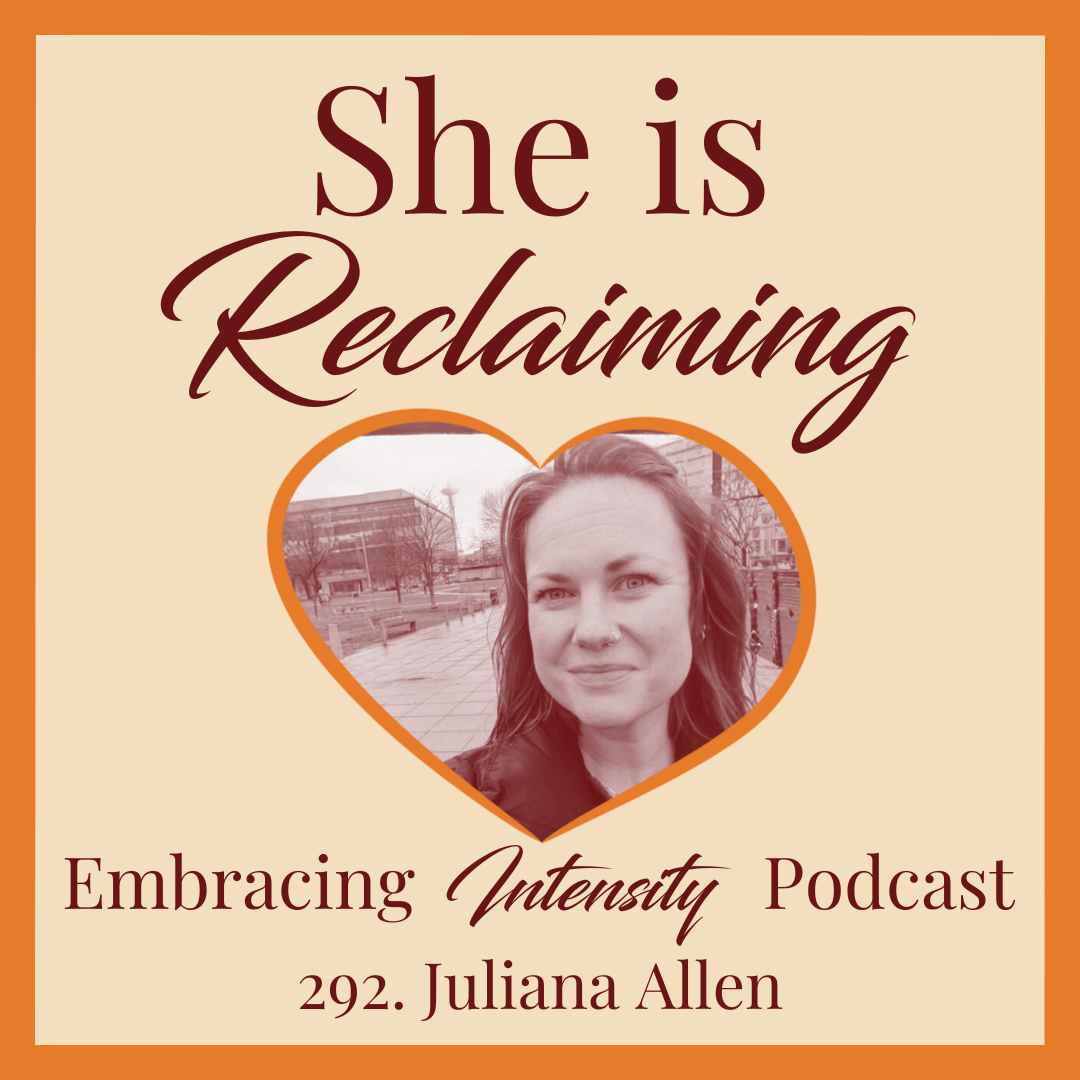
Explore More!
Giftedness * Identity * Intensity * Neurodivergence * Positive Disintegration * Relationships * Self Care * Self Regulation * Twice Exceptionality
In This Episode:
- How overriding the body begins early – through school structure, dance culture, and social conditioning
- The connection between perfectionism, eating disorders, and nervous system dysregulation
- What it was like to come out later in life during the pandemic
- Why many of us were never taught to know what we actually want
- The role of somatic experiencing in trauma healing
- Why nervous system capacity determines how much we can hold – emotionally and relationally
- The difference between artificial regulation (like forcing calm) and true embodied regulation
- Why grounding is essential for fiery, “windy,” or ADHD-leaning personalities
- How intensity becomes a gift once we learn how to stay with it
- Increasing your capacity so you can better serve others – and expand impact outward
Key Themes
Reclaiming the Body
Juliana speaks candidly about years of overriding hunger cues, emotions, sexuality, and discomfort – and how learning to “stay with” sensations changed everything.
Nervous System Capacity
The more regulated your nervous system, the more you can hold – for yourself and for others. Capacity expands impact.
Intensity Isn’t the Problem
Intensity feels overwhelming when we don’t know how to be with it. But when grounded and embodied, it becomes power.
Grounding as a Daily Practice
Especially for those who feel “airy,” fiery, or scattered – grounding practices and anchors are essential.
“The more work I do personally, the more my capacity increases. The more my capacity increases, the more I’m able to hold with other people. And then the more their capacity increases, the more they are able to do their work in the world. And it just expands.”
If this episode resonated, consider sharing it with someone who’s learning to trust their body again.
And if nervous system regulation is something you’ve wanted to understand more deeply, join us in 2026 when Juliana returns to speak live inside the community.
Intensity doesn’t have to be overwhelming.
With capacity, it becomes expansive.
Transcript
* Rough Transcript *
Juliana: The more work I do personally, the more my capacity increases. The more my capacity increases, the more I’m able to hold with other people. And then the more their capacity increases, the more they are able to do their work in the world. And it just expands.
Aurora: Welcome to the Embracing Intensity podcast. I’ll be sharing interviews and tips for gifted, creative, twice exceptional, and outside the box thinkers who use their fire in a positive way. My name is Aurora Remember Holtzman. After years of feeling too much, I finally realized that intensity is the source of my greatest power.
Now, instead of beating myself up about not measuring up to my own self imposed standards. I’m on a mission to help people embrace their own intensity and befriend their brains so they can share their gifts with the world through the Embracing Intensity community, coaching, educational assessment, and other tools to help you use your fire without getting burned.
You can join us at embracingintensity. com.
Hello, this week I get to share my interview with Juliana Allen, who is gonna be speaking about nervous system regulation to kick off our 2026 speaker series, which I’m happy to announce today.
So we’re having three in the spring and three in the fall. The. First Saturday of the month, April 4th, Juliano will come back to talk about nervous system regulation. Then May 2nd. We’re having a return of Dr. Kimberly Douglas who’s gonna be talking about owning your worth. Then on June 6th, Inger Sheey will come back and talk about Neurodivergent energy management.
And then in the fall, October 3rd, we’re having Angel Ocasio on finding humor in the mundane. Then November 7th, Cosette Coco Leary will be talking about moving from surviving to thriving. And then we’re gonna finish off the year on December 5th with a conversation with me about finding your people.
Join us in the embracing Intensity community@community.embracingintensity.com to follow our calendar, which will be up soon.
Welcome to Embracing Intensity Today. I’m super excited to have Juliana Allen, who’s been on my list to interview for a long time, and we’re planning to come back to talk with the community about nervous system regulation, which is a topic I’ve definitely wanted to cover for a long time. But you also have a very interesting story, so I’m excited to talk and hear more about you.
So tell me a little bit about yourself and what you are intensely passionate about.
Juliana: Hmm. First of all, thank you for having me. I’m really excited to be here. It’s like, I love like just seeing really badass women be really great at stuff. So I’m just like super excited to be here and be chatting with you about all the things that we are passionate about, you know.
Aurora: Yeah.
Juliana: So a little bit about myself. Juliana Allen, I use she her pronouns. And I always find that question so big, right? ’cause it’s like, what facet do you wanna, like which version of me do you wanna know, right? Like how I. Do you wanna know the professional life? Do you wanna know coming out as a lesbian later in life?
Do you wanna know, you know, all all these different things. And so I think what I’m gonna share is that I am intensely passionate about helping people, particularly people identifying as women get back in their bodies because a female identifying person, I was not ever taught.
How to know what I really wanted or needed. It was always this, you do what you’re supposed to do because that’s what we’ve been taught.
Aurora: Mm-hmm.
Juliana: And when I was about 35 years old, I looked around at my life and I had two little kids and like a baby baby. And I looked around and I was like, I can’t do this anymore.
I didn’t know like what was wrong. I just knew my body was like screaming at me from the inside, right? Like I had just had a baby. And this was during the pandemic too, so like keeping that context right and like something in my body just felt so off, so off. And, you know, I, I did a lot of years of unraveling it and I just want to see more people.
Not override their bodies and what they’re like supposed to, you know, whatever they’re supposed to be doing is just, it, it doesn’t, doesn’t mean anything. Right. Like, ’cause it’s not what your body wants.
Aurora: Mm-hmm. Absolutely. And that’s something I’ve. Battled for my entire adult life. I’ve had, you know, chronic pain and fatigue, and I realized that for years I thought I was compensating for my A DHD, but I realized that a lot of those coping skills were, you know, degrading my body because I was relying on urgency to get anything done.
So. Mm-hmm.
Juliana: Yeah, it’s important. It is fascinating, really. There’s so many different layers to it, you know, like mine presented in like. Oh my sexuality, right? Because I came out as a lesbian. I’m like 35. And, but there’s just, there’s so many different ways we overwrite our bodies, like all the time.
Like from the time we’re little, right? Like think about when we’re in school, even in elementary school, and it’s like, no, you have recess at this time. You have lunch at this time, and you will use the restroom at this time. And it’s like. What are we doing to ourselves, like putting ourselves in these boxes that I don’t know about you, but I know that I don’t fit in too many boxes.
And if I am put in a box, I will do everything I can to get outta that box. ’cause I don’t like that containment. Right?
Aurora: Absolutely.
Juliana: Yeah.
Aurora: So tell me a little bit more about your own personal brand of intensity. What does intensity look like for you?
Juliana: Hmm. I’ve always been a very intense person. Like, I remember even being a, you know, a, a kid in kindergarten and like crying every single day in school.
Incredibly sensitive. And that used to be something I really despised about myself, right? I was like, why, why can’t I just shut this off? Why am I feeling. Like, I remember this little, this little boy, he got hit in the face with like a soccer ball or a rock or something, right? In kindergarten. And I, I will never forget, like he like.
Like got injured, right? Like he had a black eye. And I remember like being so concerned about him and my mom tells a story, she’s like, yeah, you made me call his mom later that night to make sure he was okay. But it’s like that really takes its toll on people, especially because we’re not taught how to deal with that.
And so I struggled for a very long time like dealing with. My own intensity trying to dampen it, trying to make it smaller, trying to make it go away. Basically trying to silence myself so I could manage myself, right? Like I didn’t know what to do with all these feelings, didn’t know what to do with like, literally absorbing everything that was coming at me, you know?
So it’s a lot of years of unlearning and. Finally came to this place of like, oh, that’s one of my favorite things about myself
Aurora: mm-hmm.
Juliana: Is the intensity and the just passion for life. Right?
Aurora: Mm-hmm.
Juliana: Yeah.
Aurora: Absolutely. Well, you already answered my next question, which is how did it affect you growing up?
But do you think there were any cultural factors that affected how you expressed yourself?
Juliana: Absolutely. Let’s see how to say this out. Like. I am fully aware that I live in a privileged body. I, I grew up in ballet. And so that has this whole like perfectionistic like culture to it, right? Like in, in ballet in particular, most kinds of dance.
But ballet really gets a, gets hit pretty hard with like, you don’t show pain, you don’t show what’s actually going on inside. Right? And like, that’s how. I started dance when I was four, and so it’s like that was the culture that I lived in was You must look perfect. You must perform to.
This degree and it doesn’t matter how much pain you’re in. And, and that definitely was a pattern pattern throughout my life until I learned to not do that anymore. But, you know, culture is such a broad question. And so for me it was a lot of the dance culture and then develop an eating disorder.
And so that also has like a big. Just perfectionistic culture around it and yeah, overriding, right? Like I was so good at overriding my body because that’s what I was taught to do.
Aurora: Hmm. Yeah. And that leads right into the next question, which is did you ever try to tone yourself down or tune yourself out?
It sounds like both.
Juliana: Yeah, absolutely. And you know, having children now, it’s. Just such an interesting thing, right? Because it’s like I, I look at them and I never want them to dampen who they are. Like I, I love their intensity. I love their, you know, just slightly all over the place energy. And it makes me sad that so, so many of us that are like in our, in our generation just weren’t given that.
Space to do that, right? Like grew up in the generation where it’s like you as children, you are not seen, not heard, like you just kind of like fit in to wherever, wherever you’re supposed to go. And yeah, I mean it was a real struggle. It was a real struggle to like deal with, deal with all this going on and just not having.
Any clue how to do it. I ended up, yeah, having an eating disorder for about 15 years growing up because that was like the only way I knew how to manage myself. It was the only way that I knew, like I remember thinking or writing down. I journaled a lot, and I was like, everything will be okay.
Like I can handle things as long as I’m engaged in my eating disorder and. So, you know, in hindsight, like I didn’t understand it back then, but it was really a way for me to manage what I was feeling inside, which was really intense and I was scared of it, right, because I didn’t know how to deal with it and I wasn’t taught, and I didn’t have the support to be able to deal with that.
Yeah,
Aurora: absolutely.
Juliana: Mm-hmm.
Aurora: Tell me about a time when you felt like your intensity felt out of control. It sounds like that was an example. Is there, do you have any other examples?
Juliana: The eating disorder is really what comes to mind a lot with that question because it’s.
After you have an eating disorder for so long, it really morphs a lot and it like it, it started out as, as this way for me to contain myself, for me to be able to handle X, Y, or Z. Right? But as often happens in, I’m, I’m making a generalization here, but most forms of, of addiction, whether that word resonates or not with eating disorders, it does for me.
There’s this point where I. It kind of switches, right? So you’re no longer using that to manage life, but like now this thing has become like overwhelmed. It, it is now controlling you. And yeah, the intensity around that was just, it was just hard and it definitely, it was not, not a good time in my life for sure.
Aurora: You had mentioned the coming out midlife ish was that around the same time as your addressing the eating disorder?
Juliana: No, I was way in recovery.
Aurora: Mm-hmm.
Juliana: I developed my eating disorder about age 10 ish. Mm-hmm. And so I struggled for about, yeah. 15 years on and off,
Aurora: mm-hmm.
Juliana: And then, yeah, pretty, pretty solid in recovery for the last 10, 15 years or whatever now. But yeah, it, it, it’s interesting though how like the, the same overriding stuff that I did.
To override my desire for food or my desire for whatever was like the same pattern that I took into my, my relationships, right? Where it was like I had no idea that I could be a lesbian. Nobody told me, didn’t even like, it didn’t even occur to me and there was never any like checking in with my body about how being in relationships with, with men felt.
Like it was just what I was supposed to do. And it was, it’s a pretty big mind, mind mind game when you’re in your thirties and have little kids and have this whole life and you’re like, what am I doing here? Like, none of this is me. None of this feels true. And it was scary ’cause like, I didn’t know what felt true to me.
I didn’t know, I just didn’t know. I had no idea how to even like. Start to access, all I knew was this didn’t feel good.
Aurora: Mm-hmm.
Juliana: And that’s as far as I got right at the beginning. And that’s okay. Like that’s where it starts.
Aurora: And was there a particular catalyst in that?
Juliana: Honestly, no, not really. I get asked that question quite a bit and there, there wasn’t, I mean it was for context, I had my last child in May of 2020.
And I live in the Portland, Oregon area. And it was a hard time. Like it was the beginning of the pandemic and all the all the unrest and just society in general. And it was, I think it was a combination of all those things that just really kind of hit me.
And I remember I journal a lot, like that’s kind of been my main source of. Expression. And I remember like finally writing the words out to myself. I was like, I am a lesbian. And it took me like another year to come out to my now ex-husband. But I remember how freeing that felt, that I also remember this like massive weight of like, oh shit, like this is a lot to try to.
Undo untangle, you know?
Aurora: Yeah,
Juliana: yeah,
Aurora: yeah. I could see how that, the pandemic, a lot of, I feel like with the isolation of the pandemic people did a lot of internal. Exploration. I know my I don’t know how much you know, but my, my ex transitioned gender.
Juliana: Okay.
Aurora: Around that time. It was already a little bit before that, but we had moved out to the country, so there was already kind of some isolation which is probably the opposite of what they needed.
Now, there in, in Seattle Capitol Hill surrounded by community and it’s, it’s been great, but I think it was that, that moment of isolation of, of being able to. Turn inward that helped them to, to connect with that?
Juliana: Yeah. It’s, you know, our, our society, our cul, our culture is so just like on autopilot all the time and.
You know, everyone’s experience with the pandemic was different and unique and everything. But like the thing, the thread that I’ve seen with everybody is it really went one of two ways, right? Like it either really forced people to look at themselves and then they acknowledged whatever they were looking at, and then they may steps to change that.
Or they looked at it and were like, oh hell no. And then they dug their heels in more and, so one of two ways, and I’m thankful that, that I went the first way on that one.
Aurora: Absolutely.
Juliana: Yeah.
Aurora: So tell me a little bit about how you use your fire for good.
Juliana: Ooh, my fire’s my favorite part of myself. Yeah, so I do, so I do, I do somatic experiencing work.
That’s my that’s my thing, right? So nervous system, nervous system regulation, and. Healing trauma through the body is what it is. And like that kind of stuff fuels me, right? Like I can, it’s maybe a little A DHD, but when I get like really passionate about something, like I can, I can learn everything about it and then I can use it to do the things that I wanna do in the world.
And so that’s been like my, my through line, right? Like my central thing is like, how can I use whatever, whatever I’m passionate about in the moment for. Like, I feel like it sounds kind of cheesy, but like the most impact, right? Like it’s, we’re all doing the best we can and life is pretty freaking hard out there for if you’re paying any sort of attention, it’s hard, right?
And so it’s like the, the fire that I have inside for just trying to help people. I know, again, I feel like it just sounds so cheesy, but it, it, like, at the end of the day, that’s what it is, right? Like in whatever lane I’m currently operating in, right? Just how can we, how can we use whatever we are passionate about to build something that’s beneficial for all of us instead of just the one, like how, how can we do that?
And. You know, at this point it’s, it’s often more questions than it is answers.
Aurora: Mm-hmm.
Juliana: But I’m noticing more and more people are asking those questions and that gives me a lot of hope where it’s like, okay, I see a lot of us that are like, you know, what are your specific gifts and how can you use those?
To benefit whatever. Right. And if you don’t have a regulated nervous system, if your nervous system doesn’t have the capacity to hold, then it’s not gonna work. Right. So I’ve really leaned into the, like, okay, my role is helping people increase their capacity because we all need more capacity right now.
Probably for the long time.
Aurora: Yeah.
Juliana: Yeah.
Aurora: Absolutely. Hmm. What do you think has helped you the most with harnessing the power of your own intensity?
Juliana: Hmm. I like that question. Learning how to get into my body. Learning that even the uncomfortable feelings will pass. I was always scared that I would start to feel something and then I would like never get up off the floor again like I would.
I would just be a puddle on the floor forever. And I know it sounds silly, but it’s like I genuinely believe that. I was like, I am not, like if I like let myself feel what’s happening in here, like I will crumble and learning how to. Be with. That was huge. It was absolutely huge. So that’s been the biggest thing that’s just helped me like in life in general.
Right. But specifically when I’m talking about how intense I feel often inside learning how to be with myself.
Aurora: Hmm, absolutely.
Juliana: Yeah.
Aurora: So important.
Juliana: Mm-hmm.
Aurora: Are there any. Personal habits that have helped you to use your fire in a positive way?
Juliana: Mm, grounding. Oh my gosh. Grounding. Yeah. In addition to being a very fiery person, I also tend to be a very in, in, in traditional time medicine, which I get to study through bodywork.
There is, there’s another, it’s windy. Is another like category of, of characteristics on people. And so I, I am a very windy person, right? Like a DHD, right? And so I can easily get myself like overwhelmed with like, I’m gonna go here, I’m gonna go here, I’m gonna do this, I’m gonna do that. And for me, I have to have a daily grounding practice, or I will be off here and then I’ll be off over there, and then who knows where I’m gonna end up. So I have to be incredibly, like, disciplined in my grounding practice.
Aurora: Mm-hmm.
Juliana: Yeah, multiple times a day because I just. It is just, yeah, it is just how it goes sometimes, right?
And when things are going on in the world, it’s like you might wanna be doing that all the time. And another thing that I do a lot is like I wear a bracelet. I always like just feeling it or like just doing something tactile to really like anchor me down. Like I call these little things like my anchors, right?
Like finding, find your anchor. What’s your anchor? And so especially when we’re doing something that’s like harder for us or challenging in any way, it’s, it’s helped me a lot to have like this anchor of something to just kind of go back to right.
Aurora: Absolutely.
Juliana: Mm-hmm.
Aurora: Yeah, I, grounding is definitely something I, I should work on more.
’cause when you’re talking about, like, I definitely am not, I’m more like,
Juliana: mm-hmm.
Aurora: The fiery part of things.
Juliana: Mm-hmm.
Aurora: Both from like an Ayurvedic perspective, but also from, just like if you look at my, my ch my sign. Yeah. For example, my chart is like, I have zero earth,
Juliana: I have hardly any Earth. I air, I air, I’m like all air.
I mean air is the, is here in more appropriately translated wind in.
Aurora: Yeah.
Juliana: Traditional medicine, but yeah, yeah, yeah. I’m with you on that one. Grounding. I know how important it’s, yeah, and I can’t say I’m perfect at it because I’m not, but I can tell you that I notice when I don’t do it, and then I usually have a friend who’s like, get your shit together and ground yourself.
I’m like, mm. Okay.
Aurora: Yeah.
Juliana: Thank you.
Aurora: So tell me a little bit more about how you help others use their own fire.
Juliana: Yeah, so I, I am a, I’m finishing up, I’m now in my advanced trainings for somatic Experiencing Practitioner, which is a three year, three year trauma program.
So that was intense. Mm-hmm. Trauma parties for three years. That’s, it’s, it’s quite the, it’s quite the program, but it’s also, if I could point to one, one like piece that really just like transformed like internally and then like how I, how I do work in the world. It was somatic experiencing and that’s, I, I mean, just incredibly passionate about helping.
I, I work mostly with women but just find that. Voice. Voice again, because
it’s not usually okay for us to have one.
Aurora: Mm-hmm.
Juliana: And that’s not okay. Asking someone who’s, you know, 40, 45 years old, what’s your favorite color or what’s your, what do you want for dinner? And they can’t answer it. Mm-hmm. Because there’s no, like, we’re just walking around like so disconnected from what’s actually happening in here.
And you know, it took me a long time to not be really hard on myself. Like particularly about the coming out later in life part. Right. Because I was like, how did I not know? How do you not know? But learning to have that compassion with myself over, like, why would I have known
Aurora: mm-hmm.
Juliana: You know, I spent however many years, like overriding the most basic things in my body. Yeah. So why would I have known? That’s where I’m very passionate about is how can we teach people how to get back in there and heal whatever needs to be healed, increase your capacity so now you can go out and do whatever work you are meant to do in this world.
It’s all so interconnected, right? The more work I do personally, the more my capacity increases. The more my capacity increases, the more I’m able to hold with other people. And then the more their capacity increases, the more they are able to do their work in the world. And it just expands.
It’s really cool.
Aurora: Yeah. Yeah. That’s so important. Mm-hmm. And to be fair, I mean, the thing is we don’t know what we don’t know. Right? In my first marriage, I didn’t, mm-hmm. There were some things that were definitely missing, but I didn’t have the context or experience to know what I was missing until I experienced it later.
So, yeah, I, I get it. I fully, yeah. Is, I probably, in my first marriage had a similar experience with the chemistry part of it, even though it wasn’t a sexual preference issue. It was just there was a certain thing lacking Totally. That I didn’t know was lacking.
Juliana: Right. Yeah. You didn’t know.
I know. When I hear other people like, be hard on themselves about that kind of thing, I’m like, whatcha doing? Like, you didn’t know. Like, it’s okay. We don’t know until we know. But it’s just harder with yourself sometimes. Like it has been harder for me to find that compassion for myself in the past.
Aurora: Yeah.
Juliana: Yeah. But I’m good at it now, so most of the time.
Aurora: Well, that’s good. Is there anything else you would like to share with the embracing intensity audience?
Juliana: Mm. I think often fire and intensity can feel scary. And overwhelming for people if they’re not used to that feeling. Right. And what I wanna say is it doesn’t have to be scary.
Like there’s this idea that we have to go all into something and like you can start really slow and it’s actually. Much more beneficial, right? Like we, we do that in, in trauma work, right? Like you, you, you look at it and then you come back out, you look at it and then you come back out. And so if like, intensity and fire and that like deep stuff is like scary to you, like that, that’s, there’s nothing wrong.
Just go in a little bit and come back out a little and come back out. And that’s what I wanna say.
Aurora: Awesome. And I’m looking forward to having you come back to speak with the community. Is there anything specific you’d like to highlight for those who might wanna join?
Juliana: Yeah, we’re gonna talk all about the nervous system, all about increasing your own capacity.
It, it’s a, I I can geek out about the nervous system so much, and then there’s a lot of, there’s, there’s so many things there. Like I. I’m trained in breath work. And I don’t love breath work because I think that’s often like overriding your, what your body’s actually wanting to do. It, it’s like a false way to get yourself into, not a false way, excuse me.
It is a artificial way to get yourself into this like more relaxed state, right? And it’s like, well, maybe your body needed to be there for a minute. Mm-hmm. And then let’s like sit with that and explore that. So we’re gonna talk all about the nervous system, all about it.
Aurora: Awesome.
Juliana: Yeah.
Aurora: Yeah. And what you were saying about sitting with it, I, I feel like, yeah, that’s definitely been something that’s come up for me the last few years is like when, especially when I’m interacting with people who, like I’ve, I’ve been getting really good with, sitting with discomfort and, and uncertainty, and then I have certain friends who wanna be like super protective of me and like.
Protect me from uncertainty. And I’m like, I am doing this by choice,
Juliana: right?
Aurora: Like, because I’m, I’m seeing, you know, I’m exploring things with curiosity and, and learning and like every experience that I have, I’m, I’m, I’m seeing what I’m getting out of it. But sometimes it can be hard for other people to, like, they get uncomfortable ’cause they, they want certainty and it’s hard to sit with the discomfort of uncertainty.
Yeah. So that’s definitely been a theme I’ve been exploring recently.
Juliana: Yeah. I mean, it sounds so simple, right? Mm-hmm. Like, just stay with your feelings.
Aurora: Mm-hmm.
Juliana: Just stay with them and just notice what happens. Right. But like, it again, sounds so simple, but it is probably the hardest thing to do is to, to stay with that and still stay grounded at the same time.
Aurora: Mm-hmm.
Juliana: That is not easy. That is not an easy task. And so, yeah, if it’s harder for you to do, it’s gonna be harder to witness and other people to do as well. So it’s a really fascinating topic, right?
Aurora: Absolutely.
Juliana: Yeah.
Aurora: So how can they find out more about you?
Juliana: Ah, yes. Instagram’s probably the best way I’m on there as reclaim with Juliana.
Which is also my website, which is also my TikTok. So it’s pretty easy to find me. Yeah.
Aurora: Awesome. Well it was so great to chat with you and I can’t wait to have you back on.
Juliana: Yeah, thank you very much. Very nice.
Aurora: Looking for ways to embrace your own intensity. Join our embracing intensity community@embracingintensity.com where you’ll meet a growing group of like-minded people who get what it’s like to be gifted and intense and are committed to creating a supportive community as well as access to our courses and tools to help you use your fire without getting burned.
There’s also a pay what you can option through our Patreon where you can increase your pledge to help sustain the podcast or. Or join us at a rate that better fits your needs. You can also sign up for my free Harnessing the Power of Your Intensity, a self regulation workbook for gifted, creative, and twice exceptional adults and teens.
All links can be found in the show notes or on EmbracingIntensity. com.
Resources:
- Reclaim with Juliana
- Instagram: @reclaimwithjuliana
- Join the Embracing Intensity Community
- Free Harnessing the Power of Your Intensity Workbook