In this powerful episode of Embracing Intensity, I’m joined by the insightful and compassionate Fizzah Zaidi, a psychotherapist who specializes in working with neurodivergent individuals. We explore the complexities of executive functioning, and how understanding our brain’s unique operating system can transform how we show up for ourselves and others.
Fizzah brings deep experience from her work with high-achieving neurodivergent clients in the tech, medical, and legal fields. Together, we discuss how neurodivergent brains often struggle not because they’re broken, but because they’re functioning differently—and those differences can also be sources of strength.
About Fizzah Zaidi
Fizzah Zaidi is a Chicago-based psychotherapist with a passion for working with neurodivergent adults. Her practice supports many twice-exceptional individuals in high-demand professions, and her work includes educating organizations on how to better support neurodiverse teams. Diagnosed with ADHD just before entering graduate school, she dove deep into understanding the brain and executive functioning through continuing education and real-world application.
 Spotify
 Apple Podcasts
 iHeartRadio
 Amazon Music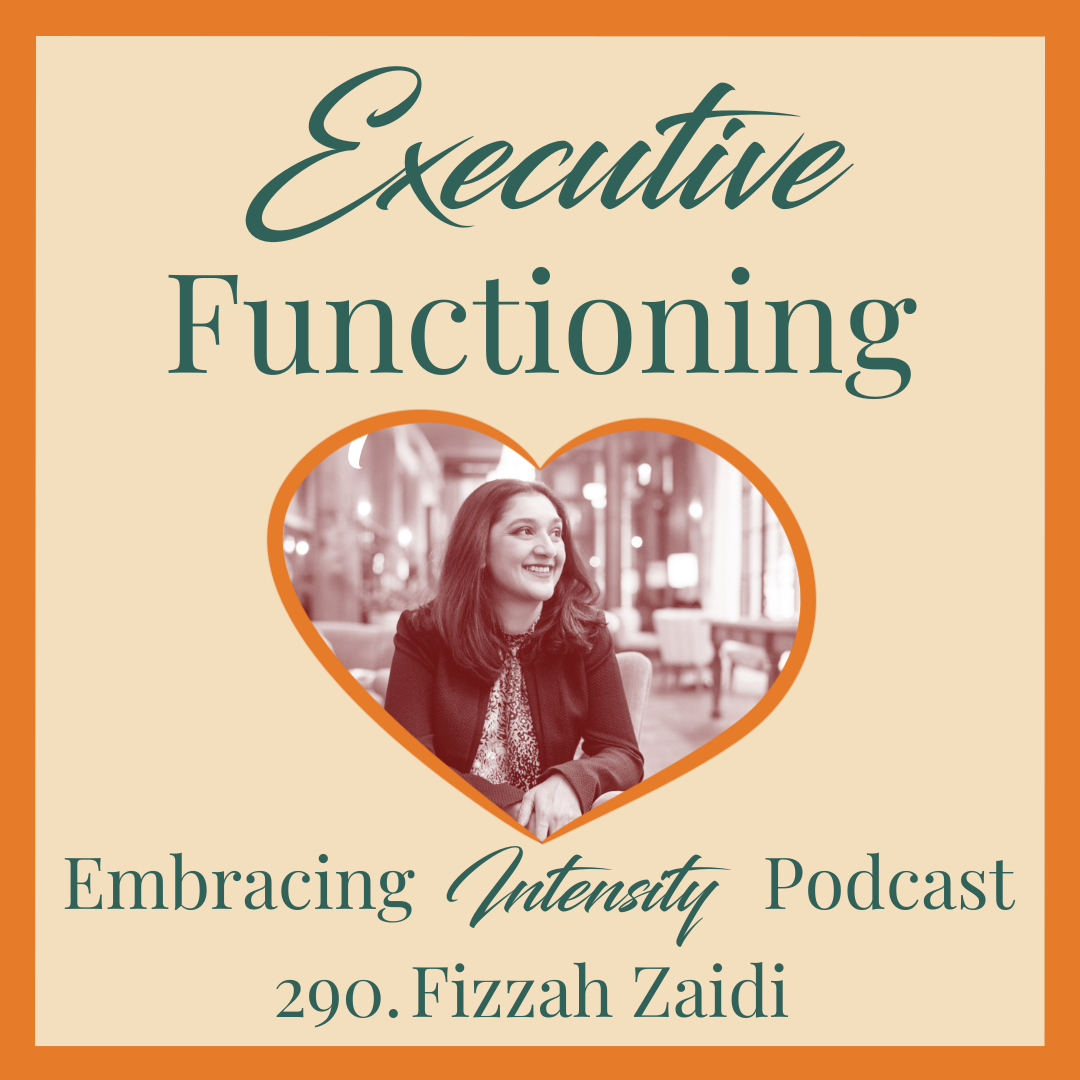
Explore More!
Giftedness * Identity * Intensity * Neurodivergence * Positive Disintegration * Relationships * Self Care * Self Regulation * Twice Exceptionality
In This Episode:
-
Why rest isn’t always about being still—and how energizing activities can also be restorative.
-
The link between executive dysfunction and rejection sensitivity.
-
How big-picture thinkers can better support task initiation and follow-through.
-
Understanding the role of the prefrontal cortex and limbic system in executive functioning.
-
Why complex tasks might be easier than basic ones for some neurodivergent folks.
-
The importance of personalized strategies over one-size-fits-all “fixes.”
-
Using self-regulation instead of self-control to support executive function.
-
Shifting the mindset from “fixing” to understanding your operating system.
Transcript
* Rough Transcript *
Fizzah: So start by admitting what is happening that’s preventing you from doing a lot of this stuff. The shame aspect is what is usually dragging us further down. One trick doesn’t fit everyone. You’re measuring yourself by execution of stuff. You are not measuring yourself by the things that you are doing that are positive.
Aurora: Welcome to the Embracing Intensity podcast. I’ll be sharing interviews and tips for gifted, creative, twice exceptional, and outside the box thinkers who use their fire in a positive way. My name is Aurora Remember Holtzman. After years of feeling too much, I finally realized that intensity is the source of my greatest power.
Now, instead of beating myself up about not measuring up to my own self imposed standards. I’m on a mission to help people embrace their own intensity and befriend their brains so they can share their gifts with the world through the Embracing Intensity community, coaching, educational assessment, and other tools to help you use your fire without getting burned.
You can join us at embracingintensity. com.
Hello. This week I get to share my final guest call on executive functioning with Fizzah Zazai, who I met at the A DHD conference last year. And one of the things that we talked about was, is rest that’s actually restful. And one of the things she brought up is that rest isn’t always. Being still, sometimes it can be doing something.
Positive that energizes us. And I really found that to be true this week as I got a lot done, but it was all creative stuff that was energizing. So I wrapped up my final workbook so you can now find all three of my workbooks on Amazon. Unfortunately, that’s the only one that does print on demand easily. There’s one on energy, balance, self-care, and empowerment. And right now they’re currently 50% off for my birthday week, my 50th birthday, and they’ll be on sale through tomorrow if you listen to this right away. So that would be. Tuesday after Thanksgiving. So if you catch this in time, you can check them out and I’d love it if you shared.
Working on my upcoming season for guest speakers. So if there’s a particular topic or speaker that you would love to see, feel free to let me know.
And as always, you can find the full discussion video in the Embracing Intensity Membership or Guest Call library. Enjoy.
Aurora: so welcome everyone. I am super thrilled to have Fizzah join us again to talk about executive functioning.
Fizzah, why don’t you go ahead and introduce yourself and maybe share what brought you to study the topic of executive functioning among other things.
Fizzah: Absolutely. Thank you so much for this opportunity. I really appreciate that.
My name is Fizzah Zaidi. I am a psychotherapist based out of Chicago, Illinois in the city proper. And A DHD kind of welcomed itself as, as everybody who is Neurodiverse knows, a DHD comes in with force. It never just gently creeps in. And that’s exactly what happened. I got diagnosed right before going to school and I was really excited to understand this and learn more about it
I didn’t, ’cause there wasn’t much of anything that was covered in it. So I took the mission on myself and sought out education, sought out conferences and CEUs, and I started noticing that the clients that I really jelled with were also neurodiverse. So it just kind of like the pieces just started fitting really well together.
I work in the financial tech district of Chicago, so I have a lot of techies, a lot of doctors and lawyers, and yet neurodiversity galore over there. A lot of type A personalities, a lot of passionate perfectionism, a lot of twice exceptional people. So it just ended up being a very, very good match in that sense.
Going through a lot of this information with them, like treating them, and I, I started to gel and bother me that there isn’t really vetted information out there. And people are trying their best to get this information. However it’s peppered with personal experience or something that was your own personal trauma that’s getting mixed up with neurodiversity.
So I have recently taken the initiative of going into businesses and now also going into clinics. And on the 14th of November, I will have my first opportunity to go to my alma mater DePaul University and start giving talks on what is neurodiversity, how to work with clients with neurodiversity, how to work with employees who have neurodiversity, just so there is a more vetted information.
Out there and like more concrete things for people to work with, except for like a fidget toy in a meditation room, which are great. But that’s not fixing anything.
Aurora: Awesome. And, If you guys have any questions for Fizzah on executive functioning I’m gonna start out with as you’ve studied this topic, is there something that like. Particularly surprised you or that you found surprisingly helpful in your studies? You know,
Fizzah: the biggest thing that surprised me and validated me more than anything I can think of was learning about rejection, sensitivity dysphoria.
That it, I was in hazed for a couple of days after hearing that was a thing that something other people felt and I made sense. And then learning more about A DHD and understanding that, like the neurobiology behind it, I mean, it makes so much sense. And the, it’s just one of those things that I feel like, it’s like an onion.
I keep. Coming across more layers. So it is rejection, sensitivity, dysphoria, and then so much more underneath it. That really provides me with validation and great information to help validate other clients. And it’s one of the things that I feel like is the biggest rapport builder between me and my clients because they didn’t know that was a thing.
Aurora: As far as the rejection sensitivity part goes I see the connection, but maybe you could share a little bit more about the connection between how your executive functioning or executive dysfunction might lead to or contribute to rejection sensitivity.
Fizzah: Absolutely. Great question. So if there any neurobiologist over here, or neuro neuropsychiatrist or neuro, anybody, please forgive me if I’m getting.
Some of the technicalities wrong. This is more brain-based than you think it is. So the biggest area of our brain that is dysfunctioning is our prefrontal cortex. It’s the last part of our brain that is developed and it is the area that houses the executive functioning skills. It’s the where, who, how, that’s where it is.
If that is the most compromised part of our brain. Our brain is trying its best to compensate for it. So it uses the limbic system to make up for the. Prefrontal cortex. So the limbic system is the emotional part of the brain. That’s where you have your amygdala, the fight, flight, or freeze part of your brain.
And our brains, you know, we’re remarkable creatures. If you think about it. If somebody is either born blind or goes blind, our body figures out a way to compensate for that by heightening other senses, maybe our sense of hearing or maybe smell, or whatever the case may be. It’s trying to compensate for it.
So the same thing is happening over here as our brain is trying to compensate for that difficulty to smoothly go to our prefrontal cortex. So because we’re using the limbic system to process things that people use, the prefrontal cortex, the logic part of the brain, a lot of our experiences are connected to emotions.
And if our emotions are what is determining things, we are more sensitive towards the absence of logic or despite there being a logic, it still is, the emotion is taking over. So there is just a higher tendencies to have experiences and reactions to those experiences that are just like dialed up a notch, if you wanna think about it that way.
Aurora: Yeah, I can definitely see that. You had mentioned that a lot of the folks that you work with are in the tech industry and likely twice exceptional. Which is a lot of our audience would be in that category.
And so I would love to hear your take on, why for some people like really complex things can actually be easier than the basic things.
Fizzah: That is such a good question. Going back to the brain-based answer for a little bit. So people who are in the tech industry, for example they are really good at recognizing patterns and using more of their quantitative thinking numbers in that sense, or patterns within the numbers, like figuring out how one precedes the other and using that as a way to solve things.
Now, language or communication of that thing is a different part of the brain. Being able to communicate that is a barrier because we’re not as proficiently going back and forth between the two hemispheres of our brain. So, to give you an example, a client of mine once said that Fizzah, I really dislike the interviewing process because I wish the interviewing process was like, you know what, let me just show you and not have to sit there and talk about it.
Because if I could just get in there and show them that I know this stuff, it will totally change the whole perspective of who I am and how I will be as an employee. And because connecting in the other direction is a challenge they compensate for it by using pattern recognition, creativity, or like big ideas and whittling them down to really micro details and so on and so forth.
Aurora: That brings to mind what has been your experience with those who tend to be more big picture thinkers versus those who tend to be more detailed thinkers?
Fizzah: I think this is why I have such a great rapport with my clients in the tech industry and finance, all of that, you know, type A personalities.
’cause I’m a very qualitative thinker and I am the big picture person and I am moving a lot faster in my observations and conclusions than somebody who is just really narrowed in and trying to understand all facets of this pattern or specific thing to unravel. And so it’s not that neurodiverse people are only quantitative or qualitative.
Only qualitative there is. Mix is in between, but my strength is in looking at the bigger picture. And we need absolutely both types of brains to evolve. So I need my quantitative folks to do the thing that I am to find and have this big idea about and they need me to give them this big idea so they have something to do.
So if you just think evolutionary how important that was, somebody needed to figure out, this is the grand plan to survive, we’re gonna need this and that. And then they were people who were executing that or figuring out how to execute it in the most wonderful way possible. So evolutionary perspective, we have been there since the beginning and helping the population further by these two different outlooks.
Aurora: Yeah, it’s so true. And I always think like being a big idea person, if I only had someone to be the implementer, and I think there’s actually probably three aspects of it. There’s like the big picture and then there’s the planning it, and then there’s the maintaining it. So I almost think there’s like three.
Fizzah: You’re absolutely.
Aurora: And those, yeah. Work together well
Says in the startup world, they often talk about needing one founder to be the big picture thinker, and the others need to be able to do the things. Yep, absolutely. So Fizzah I’m curious for your experience for those who are the big picture thinkers, if you have suggestions on things that we can do to help implement them and maintain them.
Fizzah: So let’s think about executive functioning skills for an example as the focus. So the big picture thinker something you just said a little bit ago, I will come up with the most elaborate beautiful plan. And this is what I say to my clients as well, is that you will have this gorgeous plan with different colors of pens and different paper and different ways of putting it out.
And it’ll be detailed, it’ll be beautiful, and it’ll be wonderful and it’ll work as long as somebody else is doing all of this. So your focus is more on the things around it than it is on the execution of it, right? So you may be a person who is good at planning and prioritizing, but you may not be good at task initiation.
Pretty much majority of the neurodiverse people are not good at task initiation, right? So big picture people, they do like the planning part. They have a tough time with breaking it down into smaller chunks and seeing what is the first step, because we wanna do it all and we want sprinkles on top, on top of that.
So this is working with an executive functioning coach. One is helpful. This is identifying the first step and the half step to the first step is helpful. This is having accountability is helpful along with allowing us to recognize is our focus, that end picture, because we get so focused on that end picture, we forget the steps in between.
And once we start taking the steps in between, it gets discouraging and that end picture becomes fuzzier and fuzzier by the minute. So this is where the lack of sustained attention is. A wonderful asset and also, you know, a curse at the same time where you think of the most elaborate, beautiful thing, and you have thought of it being so elaborate and beautiful because yours are so hyper aware of everything happening around you.
So you’re a little bit more creative. But the practicality of executing it, that involves different kind of thinking. So resources for sure. Having people who are doing certain parts of certain things, so you are not doing all of it. Like my private practice, I actually know work with insurance really well.
I understand their tricks and trades, but I still hire somebody to do that for me. Same with the accounting, same with these different aspects because why am I putting myself in so much stress where there are other resources that can take parts of it that I really dislike. Or don’t wanna put energy into.
And this is where creativity will come in place. You know, I’m not saying everybody has to hire people. If you can do that, great. But you’ll have to really be honest with yourself, what do I want to do in this? What do I don’t want to do in this? And thinking about it in that way in smaller chunks.
Aurora: Absolutely. It’s funny, I always thought it, I feel like I heard someone mention an app idea of like matching neurodivergent people with the big idea, people with the implementers. I just think that would be great.
Fizzah: Absolutely.
Aurora: And some comments spying on me, glances at all my markers. Try to get into a position with an assistant and a team.
At least that’s my hope. Yeah, that’s I feel that, and it’s part of why I’m back in the school system full time, just because, hopefully then I can hire some help with some of the minutia of my where I can just create to create and not have to necessarily make money at it. . Any other questions?
In the chat? I’m gonna go ahead and open up for discussion a little bit early ’cause I know a few people have to leave early.
Discussion
Aurora: I wanted to circle back to something brought up when we were talking about that kind of feeling of when you’re resting, you’re just kind of, you know, flat, but that, that brings to mind something that has been a challenge for me lately.
And because I went back to full-time work as a school psychologist because I was struggling with that so much, and also marketing myself, I hate the marketing aspect of everything. I love to create, but I hate to sell. But the other piece was that like I just, when I have an indefinite amount of time to work on things, like I just couldn’t force myself to do these things because there wasn’t that same urgency.
So I’ve kind of resigned myself to just. Going back into the school system, I’ll have my summers off. I’ll have times where I can be creative and I don’t have to make money off of it. But that brings another challenge, which is to avoid burnout finding like, rest that is actually restful.
So I would love to hear from you if you have thoughts on how to make rest actually restful
Fizzah: that, that’s a really good question. So many things were flashing when you were saying when you were explaining what your experience. I love how you actually took yourself back to structure to give yourself that differentiation between work and rest.
It created some sort of a, hard line between it. Right. The thing I know I have shared or asked my clients and shared with that clients is that rest in our mind comes to either sleeping or sitting on the couch. And it doesn’t have to be an activity that is also inactive or not as engaging.
It can be quite the opposite. So if I am feeling more energy by putting on a podcast I’m listening to and cleaning my house. And that is a sense of relaxation. You’re doing a thing that you are enjoying, you’re giving yourself the pep energy of listening to the music and you’re doing it. And then there’s also a feeling of accomplishment that comes with it.
One, there’s the differentiation between needing the rest and sitting on the couch. See if you can identify and focus on the dread.
I don’t want it do with this
if that’s showing up. There is that resistance part and you’re resting to avoid sometimes, or it feels too big or there are other factors happening.
But if rest is not feeling like a labor in itself you are. Resting, whether sleeping feels really good or watching this movie right now actually feels really good and I can, and can focus on this movie but if that dread part is over there, I wonder what we’re avoiding that is giving us that nagging feeling.
And going back to the example was also like identifying that energy and in naming the energy because maybe it’s just draining us and we don’t need to put our lot of focus on it and maybe we can just enjoy our movie.
Aurora: It is so funny too because I realized like last week I had this garage project that I was working on and I had a class a comedy class that I took on Wednesday.
So last week I had something. Every single night I did something productive after work. And this week I didn’t have those things because there’s some things I’m waiting on for other people. And then I can’t really start this project because I have to finish this first for the space. Anyway, so this week I just came home and I crashed on the couch and I realized that like, even when I was at work, I was more exhausted and more brain foggy than I was last week when I was productive after work.
So that like, yeah. And, says that’s just relative. Yeah, absolutely. I find that to be very true. So it’s finding that balance with rest, but also I I had mentioned this week, I think about contaminated time. Where you’re thinking about other things when you should be
that’s another factor. And then in the chat, I see rest for me comes only when my thoughts, emotions, and body are all engaged in the same thing. Nothing else is the trick.
Yeah. Being present in the moment for sure.
Marker
Aurora: What I do wanna connect to the executive functioning piece is that, in my early work, one of the things I wrote was, I know what to do, so why can’t I follow through? And the main point of it is was how, our fatigue and energy and all of this other stuff impact our ability to use our executive functioning skills.
And so masking and sensory overwhelm and like all of these other pieces are draining us. And then we have less capacity to implement our executive functioning skills. So it can be like a cycle, right? Where like all the things that would help us have more energy require executive functioning, but if we don’t have the executive functioning, it’s hard to do those things.
So, I’d love to hear from you, if you have thoughts on like one of the, my concepts is focusing more on the self-regulation aspect than the self-control. Because if we’re focusing on self-control, that’s forcing yourself to do these things, whereas self-regulation is more supporting yourself in doing these things.
So I’d love to hear from you on, your take on like ways to help support our executive functioning rather than forcing it.
Fizzah: That’s a really, really good question. Right. And I mean, I think it starts by having that reflection back and understanding what our version of helping our ourself is and what our version of.
You know, helping others is because sometimes either we don’t know how to not mask or we don’t know how to regulate. Or we don’t like ourselves. We’re not looking into what we need. So understanding not just one facet of it. You gave a really good example of like, there’s energy being taken from masking.
There’s energy being taken for con, you know, being conforming to the norms or whatever the case may be. Right. And then we’re also not stepping back and looking at how much energy we have used. So when we’re trying to use our executive functioning skill, we. Can’t because we’re depleted. So the first thing is actually getting used to your body, your emotion, and taking a step back and understanding where you’re hitting your threshold of tolerance and where you’re going past the threshold of tolerance and where would it be all right to stop something to go, you know, gather more energy for yourself to be able to do something.
This is where executive challenges themselves come into place. Like, so the planning and prioritizing part, right? Or the impulse control part. We have to, this is a bigger conversation in being able to reflect and seeing our individual self. Why are we giving more energy to this other thing?
What are we gaining and ’cause we’re maybe getting quick dopamine hits from these things, right? So what do I need to do to regulate where I’m not dependent on the dopamine hits? And that’s a lot of introspection. That’s the first thing to start.
Aurora: So I was just looking in the chat part. But connected, I think in a way, especially in the definition of executive functioning, doing taxes on time, meeting deadlines, et cetera, prioritizing and executing tasks that are relevant to aliveness. Yeah. Yeah, definitely.
So, I would love to hear if you guys have like final thoughts and then I’ll circle back to Fizzah at the end for, for her final thoughts. And yeah, I just wanna
Fizzah: add on to what you just said. This is you know, I think that planning and prioritizing and figuring out what is more important, what is next important, so on, so forth.
It’s important to, first of all, for us to figure out the system, right? And figure out, okay, I have taxes, I have to do, I don’t want to do them. That’s gonna take too much time. I also have to clean the house that’s gonna require X, Y, and Z things. Let’s understand the values of all of that and what’s preventing us from doing that.
So the preventing aspect or the understanding what prevents us from execution or what prevents us from doing planning and prioritizing. We’re kind of giving ourselves answers to a lot of things. The problem is that we shame ourselves for some of those answers, and some of that sometimes it’s just like, I don’t wanna.
That’s just not good enough for us to be like, I don’t wanna, but maybe we can work with that and understand that I don’t wanna is a fine answer. How do I make it less painful and just, I don’t wanna, right? And this is where it will come into play. Like, you are not doing taxes ’cause you don’t like numbers.
It’s boring. It takes a lot of time. This is where, okay, this is the deadline that I have. I don’t like doing this. Do I wanna hire someone to do that? Do I need to have somebody who is going to work with me and help me understand some of these things? Then I will do that. Do I want to do this first page today and the second page tomorrow and building these different tasks not tasks tricks.
I’ll have to start with you understanding what works for you. So, you know, I will say, Hey, use the Pomodoro method, fantastic method. If some it works for you, great. If it doesn’t work for you, that’s also okay. Our job is to figure out what works for you first, not just plug in different tricks or apps or things like that.
We get more focused on those things and them trying to give us that specific result than focusing on, well, I’m not, I’m never gonna do this. Like, I really don’t like taxes. I am going to avoid it like the plague. Maybe I need to say this to somebody and they will help me come up with different things that I feel like I can trust.
Talking to them about it.
So start by admitting what is happening that’s preventing you from doing a lot of this stuff. The shame aspect is what is usually dragging us further down. One trick doesn’t fit everyone. You, you’re measuring yourself by execution of stuff. You are not measuring yourself by the things that you are doing that are positive.
Aurora: Absolutely. Thank you so much.
Marker
Aurora: A lot of good points there. So wrapping it up, do you have any final thoughts you would like to share?
Fizzah: Always, and, no. No, but no, I always do. I think one of the things that I come across with A DHD and actually working with A DHD clients is the focus on the word fix.
And we, executive functioning skills is one of those that we see only if I have this, then I will be fixed. And the way I want to see if we can open our eyes and understand executive functioning skills. It’s more like understanding your program. I use this example all the time. It’s MAC versus pc.
They’re both operating systems. They both do the same thing. We all go to the internet. We all do, but they’re two different operating systems. So trying really hard to find an Apple key. When you need a Windows key, he is working against you, but understanding your manual and how you work, you can do that same thing that the other computer is programmed to do.
So executive functioning skills is not about fixing things, it’s trying to understand what’s. Dysfunction. And what’s the function for that dysfunction and how is that dysfunctional helpful? I want to be able to eliminate the need to fix and more in understand, because fixing is a bandaid. If we’re not understanding the actual thing, we’re gonna be constantly replacing that bandaid.
Aurora: Awesome. I love that. It’s a great analogy. Well, thank you so much for joining us. Thank you guys for joining on the call.
Looking for ways to embrace your own intensity. Join our embracing intensity community@embracingintensity.com where you’ll meet a growing group of like-minded people who get what it’s like to be gifted and intense and are committed to creating a supportive community as well as access to our courses and tools to help you use your fire without getting burned.
There’s also a pay what you can option through our Patreon where you can increase your pledge to help sustain the podcast or. Or join us at a rate that better fits your needs. You can also sign up for my free Harnessing the Power of Your Intensity, a self regulation workbook for gifted, creative, and twice exceptional adults and teens.
All links can be found in the show notes or on EmbracingIntensity. com.